
Contents
Quick summary
- Decision fatigue in trading means that the more small choices a day holds, the worse later ones get. The fix is deciding in advance, not more willpower.
- Tiredness, stress and short sleep dull what trading depends on: attention, patience and rule following.
- A routine that holds up: a written plan, a quick check on your own state, a fixed window, a scheduled break and a stop time.
- Trade fewer instruments and shrink the choices inside each trade with checklists, price alerts and fixed risk. Guard sleep like capital, and judge each week by rule following, not profit.
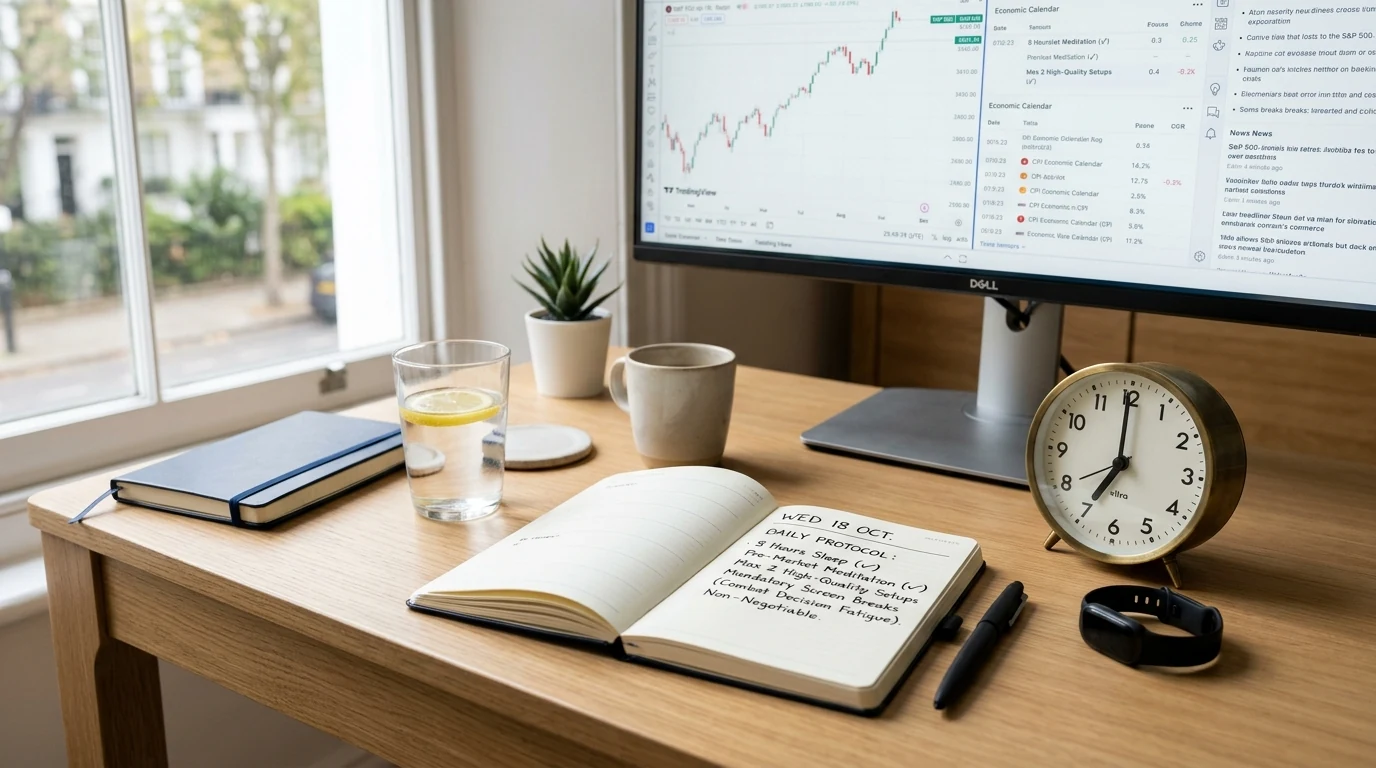
Decision fatigue in trading is the slow drop in decision quality that comes from making many small choices in a row. Stress and short sleep add to it, and together they wear an account down quietly: attention scatters, patience shrinks and your own rules start to look negotiable. The person at the screen at ten at night, after a full workday, is the analyst who made the plan that morning, with less capacity to refuse a mediocre entry. The short answer: decide the important things while your mind is fresh, only execute when you are tired, and arrange your hours so that sleep is never what gets sacrificed.
None of this is medical advice; these are practical tools to test against your journal. Preserving cognitive bandwidth is central to maintaining emotional discipline and trading mindset throughout volatile market sessions, ensuring execution quality remains steady regardless of external stress.
What tiredness, stress and short sleep do to a trader
Attention: small things slip
Simple errors multiply when you are tired: an extra zero in the position size, an order sent the wrong way, a forgotten stop loss, a scheduled release you knew about and missed. That is not ignorance; attention has simply run out.
Patience: waiting gets harder
Holding out for a complete setup (the entry conditions your plan defines) gets harder. Early entries, profit grabbed too soon and “one more trade before I go” start here.
Rule following: exceptions pile up
“This one is different” is easy to say with a drained mind, so rules must need little willpower.
Decision fatigue in trading: why small choices add up
The idea is that a long run of decisions lowers the quality of later ones. Researchers still debate its exact scientific form, so it is no law, but most of us know how attractive the easy option looks late in a choice-heavy day. In trading, it means an entry with no reason, a stop loss pushed further away, or a position closed because it feels uncomfortable.
The hidden decisions inside one trade
A trade is more than buy or sell. Which of these do you decide afresh each time?
- Which instrument today, and on which timeframe (the span of time each candle covers)?
- Is this signal my setup, or merely something that resembles it?
- Where do the stop loss and target go, and how large is the position?
- Enter now or wait a candle? Hold or close?
Each item you re-decide uses up the day’s capacity; settle most of them once, in writing, before the day starts.
Rules in place of choices
“Every trade risks the same fixed percentage of the account” is a calculation, not a decision, and a position size calculator makes it quick.
A daily routine: preparation, a fixed window and a stop time
A routine moves the big decisions ahead of the market, so a tired mind never makes them all at once.
- Plan before the session: on paper, list two or three instruments, the levels, the setups you allow and the scheduled releases. If a major release is coming, decide that morning whether you trade around it or stay out (check its time in the FundoraTrade economic calendar).
- State check: before opening the platform, answer three short questions (below).
- A fixed trading window: trade in the same hours each day, not from morning to night, so attention stays concentrated.
- A planned break: at least one short break in the middle: stand up, drink water, look away. It belongs to the plan; it is not a reaction to a loss.
- A stop time and a short log: a written time after which you do not trade, even if a setup appears. Close the platform, record results and add one sentence for tomorrow.
The three-colour state check
Answer yes or no before each session:
- Was last night’s sleep enough for me?
- Is my energy at least 3 out of 5?
- Is my mind free of urgent problems outside the market?
Three yes: a normal day, trade the plan. Two: cut risk per trade and cap the day at one or two trades. One or none: no trading today; review the plan and journal instead. These thresholds are examples; tune them against your journal and write them on a calm evening, not on the morning of a bad day.
Fewer decisions, more execution
You cannot always remove fatigue, but you can shrink the decisions made under it. Three simple tools:
- A pre-entry checklist: five to seven yes-or-no lines. A single “no” means no trade, without debate.
- Price alerts: alerts at the planned levels replace continuous watching.
- Fewer instruments: know two or three markets well, not ten superficially; each extra one lengthens the day’s decisions.
| Factor | Skill it weakens | How it shows up in trading | Pre-decided response |
|---|---|---|---|
| Decision fatigue | Quality of choice, pull toward the easy option | Entries with no reason, stop loss moved | Checklist, fixed risk, cap on trades |
| Stress | Patience, tolerance of normal swings | Profit closed too early, alarm at ordinary moves | Short reset, pause until calm |
| Poor sleep | Attention, care with details | Errors in size or direction, a missed release | Smaller risk, or no trading today |
Late sessions from Iran: protect your sleep
For a trader in Iran, the busiest part of the US market tends to fall in the evening and late at night. Tehran time is fixed (UTC+3:30, no daylight saving), while the US and Europe change their clocks twice a year, so the gap to New York or London shifts twice a year. Recheck your session in Tehran time each season.
Fit the window to your life, not the reverse: if a session runs near midnight, trade a few set days a week, take only its first part, or pick a market active at a friendlier hour.
Three rules that protect sleep:
- Set the stop time at least half an hour before bed so your mind can settle.
- After a night of poor sleep, skip trading or deliberately cut risk and trade count.
- A position with a stop loss can be left overnight, remembering that price sometimes jumps past a stop, so the real loss can exceed the plan slightly. A position without a stop should not have been opened.
Stress signals and a quick reset
Stress is not always felt as anxiety. Common signs: constant glances at live profit and loss, restlessness when price moves, the thought “I have to make it back”, chart-hopping and irritability.
A short reset (general suggestion, not treatment):
- Take your hand off the mouse and breathe slowly a few times, with the exhale slightly longer than the inhale.
- Walk for five to ten minutes.
- Drink water, then ask only: “Is my next entry in the plan?”
If anxiety, insomnia or gambling-like behaviour lasts or disrupts daily life, a mental health professional can help; asking is sensible, not weak.
Weekly review: energy against rule following
Add columns to your journal and fill them in after each stop time: the colour from your state check, roughly how long you slept, the number of trades, “were all rules followed?” (yes or no) and the result in R (a multiple of that trade’s initial risk; a loss exactly at the stop is minus one R). At the end of the week, ask these instead of totalling profit:
- On low-energy days, how was my rule following?
- At what hour do most rule breaks happen?
Rule following matters more than profit; a profitable day with broken rules is a bad sign. If a pattern appears, change the window, stop time or trade cap.
Hypothetical example: a planned day versus an unplanned one
This scenario is hypothetical, and the clock times serve only the arithmetic, not as a recommendation. A trader keeps six instruments open, sits at the charts from 14:00 to 01:00 and checks each instrument about ten times: six times ten is sixty “should I enter?” moments.
Now the same person writes a plan: two instruments, three scheduled checks each (2 times 3 is six decision moments), at most three trades and a fixed risk of $50 per trade. At worst, three losses in a row cost $150. The day:
- 16:30 to 17:00: preparation, state check and writing the plan (30 minutes).
- 17:00 to 18:00: first trading block (60 minutes).
- 18:00 to 18:15: a break away from the screen (15 minutes).
- 18:15 to 19:00: second block (45 minutes). Together: 60 plus 45 is 105 minutes of trading plus the 15-minute break, two hours.
- 19:00 to 19:15: stop time; close the platform and log the results.
Sixty decisions became six, the day’s risk has a ceiling and sleep is protected in the plan.
Common mistakes
- Trading a late session after a full workday, when focus often sags and simple errors become likelier.
- Staring at the screen all session: more looking means more temptation.
- Having no stop time, saying “just one more trade”, and never recording energy or sleep.
Make your routine more precise
With the position size calculator, pip value calculator and strategy simulator, turn repeated decisions into ready calculations.
FAQ
How many hours a day should I sit at the charts?
There is no fixed number. Start with a short, fixed window, perhaps one or two hours with a break, and let your journal show when you follow your rules best.
If I slept badly, should I trade anyway?
Write the answer in advance, on a calm evening: skip trading, or trade with lower risk and no more than one or two trades. Do not leave it to the morning itself; a tired mind quickly decides that today is an exception.
How do I know I am tired?
Watch behaviour, not feelings: simple entry mistakes, a forgotten stop loss, a skipped checklist or repeating “just one more”. With two of these, take a reset break or end the session.
What if I only have time late at night?
Pick a day after a lighter workday, set a strict stop time, cap the trades and follow one instrument. If the state check comes out weak, staying out is a valid decision.
Can I take a break while a position is open?
Yes, provided it has a stop loss and the risk is what you calculated before entry. The stop can fill a little away from the planned price. A break without a stop only postpones the worry.
Further reading
Risk warning: Trading financial markets, including forex and futures, carries a risk of losing part or all of your capital and is not suitable for everyone. This article is educational only; it is not investment advice, a trading signal or medical advice, and it does not replace professional advice. Trade only with money you can afford to lose.