
Contents
Quick summary
- Revenge trading is a trade opened to win back a loss, not because a setup from your plan has appeared.
- The usual chain: loss, anger or shame, bigger size and looser rules, bigger loss.
- The fix is written rules, not more willpower: a daily loss limit, a mandatory stop, a step-away routine and conditions for returning.
- Make mistakes harder: hide live profit and loss, cap the trades and read a checklist before every entry.
Revenge trading is a trade placed for one reason: you want back money you just lost. A quick test: if the previous loss had never happened and you would still take exactly this entry at exactly this size, the trade is legitimate. If the main reason is “I need to make it back”, it is revenge.
Almost every trader has felt this pull; what differs is who built an exit route in advance. Below are the warning signs, a stop protocol, environment changes and a worked example of how one unplanned trade can double the day’s loss. Breaking this destructive cycle requires internalizing core trading psychology principles, where risk boundaries take precedence over emotional reactions.
What revenge trading actually is
A normal trade starts outside you: the market meets a condition in your plan and you act. A revenge trade starts inside you: something hurts, and the market looks like a way to make it stop. The chart may be identical, but the reason for entering has changed.
Despite the name, the opponent is rarely the market, which wants nothing from you. Underneath sit refusal to accept the loss, shame, fear of a “ruined” day or a need to prove you were right, so “better analysis” does not fix it. Nor is every loss revenge trading: a stop that gets hit means the plan did its job. The error is behavioural, and it drags technical ones along: an entry with no setup (the conditions your plan defines for getting in), larger size, a wider stop or none.
The chain from loss to bigger loss
Knowing the links lets you step off midway.
From loss to anger or shame
The stop is hit and your body reacts: hot face, tight shoulders, faster pulse. That is normal. Then anger says, “the market cheated me, I’m going back in”, or shame says, “I got it wrong again, I must prove I can do this.” Both want a red number turned green. This is a common experience, not a medical condition.
From bigger size to bigger loss
The hidden logic is, “if I size up, one trade fixes everything.” The stop moves further away, a half-met entry condition gets accepted, and a trade opens that you would never have taken without the earlier loss. If it loses, the damage is several times your normal risk. If it wins, that may be worse: the mind can record “that worked” and repeat it, though one outcome says nothing about the decision.
Warning signs before you pull the trigger
- You want the next trade at once, without re-reading the chart.
- You hunt for “movement” instead of a setup, and every big candle tempts you.
- You pick size by the amount you need back, not by the distance to your stop.
- Your body is tense: clenched jaw, shallow breathing, a restless hand on the mouse.
- You tell yourself “just this one” or “last time”.
None of these means weakness; they mean this is not the moment to decide. Keep the list near your screen.
A stop protocol: write the rules before the bad day
Write the protocol when you are calm, not after a loss. The stung, angry version of you did not write the plan, so do not let it renegotiate. Keep the rules on paper, visible before each session.
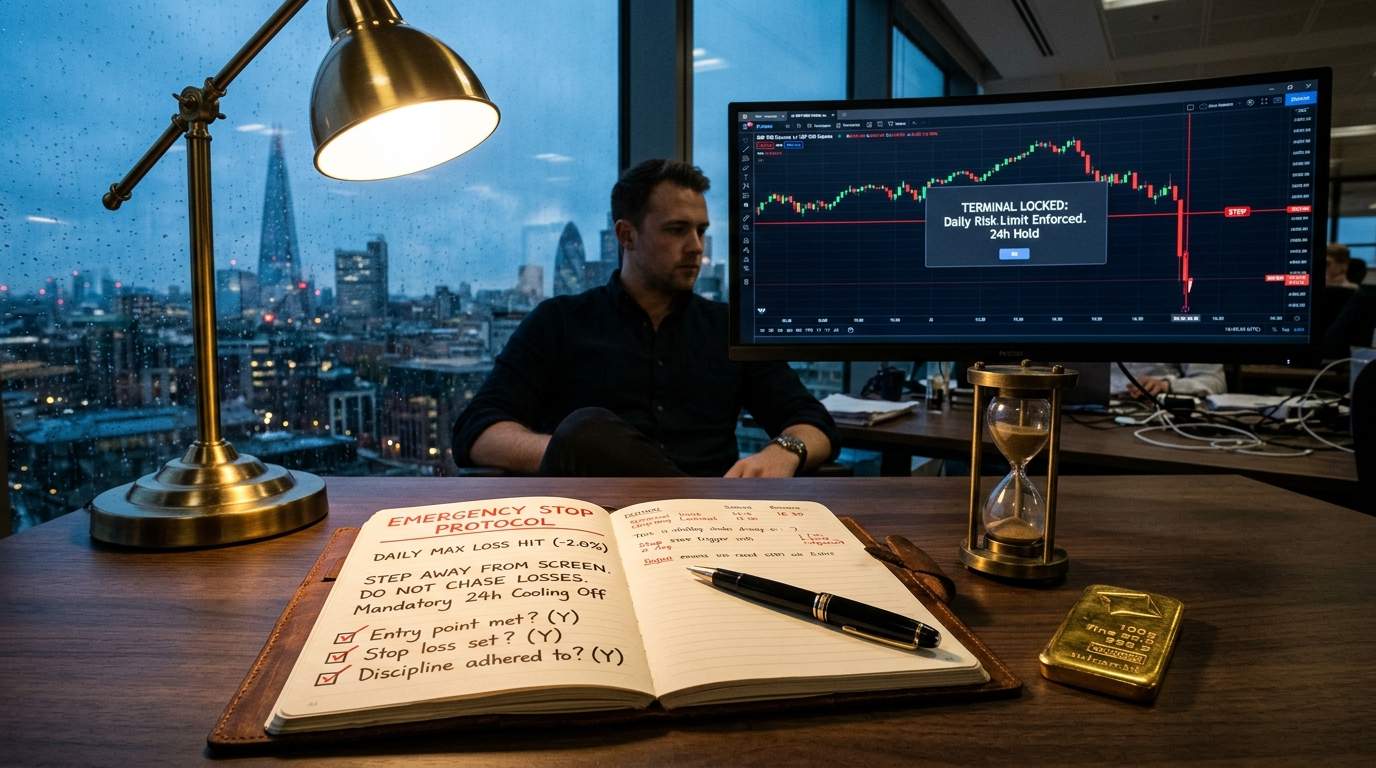
- Set a daily loss limit in advance, for example twice your single-trade risk (2R, where 1R is the amount you risk on one trade). It must fit your account size and per-trade risk.
- Write a mandatory stop: at the limit, or after a set number of consecutive losses, the platform closes and the day is over. Not “maybe one more”.
- Define a step-away routine: stand up, drink water, walk a few minutes, so your body leaves the heightened state.
- Write return conditions: a minimum time away, a short note on what happened, and a re-read of your plan. The next day, log yesterday’s loss first; the goal is one full day by your rules, not recovery.
- Do not raise size after a loss. If you return, start at normal or smaller risk.
Why the rule must be written and absolute
A rule that applies only when you “feel fine” is a suggestion; the stop should work like a red light. If your platform offers a daily loss lock, turn it on. On a prop account (one a firm gives you under its own rules), the firm’s daily drawdown limit is the last line; your limit should sit well before it. A prop firm drawdown calculator lets you check that.
Redesign your environment: make the wrong action harder
Willpower alone is unreliable in the moment, so make the mistake harder to commit.
Hide the number, cap the trades
Many platforms let you remove the open profit-and-loss column; if yours does not, tape paper over it. A dollar figure always in view ties decisions to that number, not to market structure. Also cap daily trades, for instance at three, even if all three win. A paper tally is enough.
A pre-trade checklist
Before each entry, answer these out loud or on paper. Copy the list as it is:
- Is the setup complete according to my written plan, or am I “interpreting” it?
- Where is my stop, and how many dollars does this trade risk?
- Did I calculate size with a formula or with a feeling? (A position size calculator does the arithmetic.)
- If the previous loss had not happened, would I take this trade?
- Am I calm, or reacting to something?
- If this trade also loses, does my daily limit still hold?
If any answer is “I don’t know” or “no”, do not enter. It will not make trades win; it blocks the ones from outside your plan.
Legitimate re-entry or revenge trade
A loss does not ban the same setup; sometimes the market rebuilds your entry conditions after stopping you out. The difference is motive and rules, not whether a second trade exists.
| Criterion | Legitimate re-entry | Revenge trade |
|---|---|---|
| Trigger | A new setup that meets the plan’s conditions | A need to recover the previous loss |
| Size and risk | The normal risk from the plan | Larger than usual, justified by “until it’s back” |
| Stop loss | Set in advance at a structural point | Far away, movable, or missing |
| Journal entry | The reason is clear and easy to write down | The real reason goes unwritten or is justified afterwards |
In borderline cases, skipping is the cheapest option: another opportunity will come, but the cost of an emotional entry will not.
Hypothetical example: one unplanned trade doubles the loss
This example is hypothetical and only shows the arithmetic. Assume an account of $10,000, risk of 1% per trade ($100, or 1R) and a daily loss limit of 2% ($200, or 2R).
- Trade one: a valid setup, stop hit. Loss $100; day total minus $100.
- Trade two: valid again, stop hit again. Day total minus $200, exactly the limit.
Under the protocol the day ends here: a 2% loss you accepted in advance, balance $9,800.
Now the other version. After the second loss you ignore the limit: “one good trade will bring it all back.” There is no setup, but you double the risk to $200 and the stop is hit. The day total is minus $400: 4% of the account, twice your limit. The balance is $9,600, and getting back to $10,000 now needs about a 4.2% gain ($400 ÷ $9,600 ≈ 0.0417), because the base is smaller.
Had the third trade won $200, the day would have ended flat, but the lesson would be wrong: “break the rule, it works.”
Journal the trigger, not only the trade
After a bad day, write a few lines about what set it off. Four questions are enough:
- What was the loss just before it, and at what time?
- What was the first warning sign: a thought, a body sensation or an action?
- Which rules did I break or keep?
- What will I do differently next time?
After a few weeks a pattern appears, such as a certain hour or kind of loss that stings most. That pattern becomes your next rule.
Common mistakes
- Keeping the rules “in your head” instead of on paper, where a bad day can renegotiate them.
- Setting a daily limit and moving it the same day.
- Stepping away without closing the platform, then coming back after a few minutes.
- Trading another account to “win back” the loss on your main one.
If you cannot stop despite your rules, or stress is hurting your sleep, work or relationships and your trading looks like gambling, talk to a mental health professional.
Put numbers on your limits and risk per trade
Fundora Trade has tools for position size, pip value, drawdown and strategy simulation, so you can set limits on paper before a bad day arrives.
Frequently asked questions
If my stop is hit and the same setup appears again, can I take it?
Yes, if your daily limit still stands, size and stop follow the plan, and the checklist passes. Skip it if you want it faster or bigger because of the loss.
How large should my daily loss limit be?
There is no universal number. It must fit your account size and per-trade risk: small enough that one bad day does not seriously hurt, large enough that two ordinary losses do not end your day. Start from a few multiples of one trade’s risk, review it after several weeks, and keep it below a prop firm’s daily limit if you have one.
Can I just watch the market after hitting my limit?
You can, but closing the platform is safer, because live price movement tempts you. Review the chart next morning.
I blame myself after losses. Is that part of the problem?
Yes: blame produces shame, and shame strengthens the urge to recover. Judge behaviour, not yourself. A neutral line helps: “this loss was a cost of the plan, not a verdict on me.” A loss taken by the rules was not a mistake.
What if I am already in a revenge trade right now?
Hand the decision to your written rules: a trade without a setup fails the checklist. Do not move the stop further away or remove it; that enlarges the mistake. Once the trade is closed, shut the platform, step away and write down the real reason you entered.
Further reading
Risk warning: Trading in financial markets, including forex and futures, carries the risk of losing part or all of your capital and is not suitable for everyone. This article is for educational purposes only and is not investment advice or a trading signal, and it does not replace professional advice. Trade only with capital you can afford to lose.