

Choosing the right forex broker is one of the most important decisions a trader can make. Your broker affects execution speed, trading costs, platform stability, fund security, and ultimately your long-term profitability. With hundreds of brokers competing for attention, understanding how to evaluate them properly is essential.
This comprehensive guide explains what forex brokers do, how they operate, the key factors you should consider before opening an account, and how to identify the best brokers based on your trading style. Whether you are a beginner or an experienced trader, this page is designed to help you make an informed and confident choice.
What Is a Forex Broker?
A forex broker is a financial services company that provides traders access to the foreign exchange market. Since individual traders cannot trade directly in the interbank market, brokers act as intermediaries, executing buy and sell orders on behalf of clients through trading platforms.
Forex brokers provide:
Access to global currency markets
Trading platforms such as MetaTrader 4, MetaTrader 5, or cTrader
Pricing through spreads and commissions
Leverage to amplify trading positions
Account management and customer support
The quality of a broker directly impacts trade execution, slippage, costs, and overall trading experience.
How Forex Brokers Make Money
Understanding how brokers earn revenue helps traders identify potential conflicts of interest.
Spreads
The most common source of income is the spread, which is the difference between the bid and ask price of a currency pair.
Commissions
Some brokers charge a fixed commission per trade, usually combined with raw or near-zero spreads.
Swap and Overnight Fees
Holding positions overnight may incur swap fees, depending on interest rate differentials.
Market Making
Market maker brokers may take the opposite side of a client’s trade. This is not inherently bad, but transparency is critical.
Types of Forex Brokers
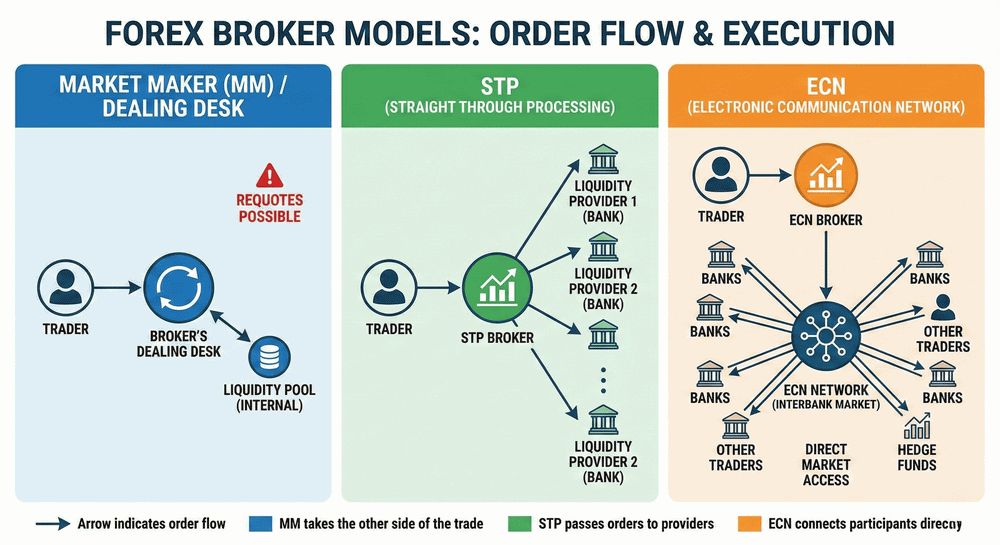
Market Maker Brokers
These brokers create their own internal market and set bid and ask prices. They typically offer fixed spreads and are often suitable for beginners.
STP (Straight Through Processing) Brokers
STP brokers route orders directly to liquidity providers without dealing desk intervention, offering more transparent pricing.
ECN (Electronic Communication Network) Brokers
ECN brokers connect traders directly to a network of banks and liquidity providers. They usually offer raw spreads with commissions and are preferred by professional traders.
Key Factors to Consider When Choosing a Forex Broker
Regulation and Security
Regulation is the most critical factor when selecting a broker. A regulated broker must comply with strict financial and operational standards designed to protect client funds.
Look for brokers regulated by reputable authorities such as:
FCA (United Kingdom)
ASIC (Australia)
CySEC (Cyprus)
FSCA (South Africa)
Regulation helps ensure:
Segregation of client funds
Transparent pricing
Protection against fraud
Trading Costs: Spreads, Commissions, and Fees
Lower trading costs can significantly improve profitability, especially for active traders.
Key cost considerations include:
Average spreads on major currency pairs
Commission structure
Swap and rollover fees
Inactivity fees
Scalpers and day traders should prioritize low spreads and fast execution, while long-term traders may focus more on swap rates.
Trading Platforms and Technology
Your trading platform is your primary interface with the market.
Popular platforms include:
MetaTrader 4 (MT4)
MetaTrader 5 (MT5)
cTrader
Proprietary web and mobile platforms
Important platform features:
Charting and technical indicators
Order execution speed
Automated trading support
Mobile trading capabilities
A reliable and stable platform is non-negotiable.
Account Types and Minimum Deposits
Most brokers offer multiple account types to suit different traders.
Common account types:
Standard accounts
Micro or Cent accounts
ECN accounts
Islamic (swap-free) accounts
Beginners should look for low minimum deposits and demo accounts, while experienced traders may prefer advanced account structures.
Leverage and Risk Management
Leverage allows traders to control larger positions with less capital. While leverage can increase profits, it also increases risk.
Key considerations:
Maximum leverage offered
Margin requirements
Stop-out and margin call levels
Responsible brokers provide risk management tools and transparent leverage policies.
Deposit and Withdrawal Methods
Fast and reliable payments are essential.
Look for brokers that offer:
Multiple funding methods
Fast withdrawal processing
Low or zero transaction fees
Payment options may include bank transfers, credit cards, e-wallets, and cryptocurrencies depending on region.
Customer Support and Education
Strong customer support can save time and prevent costly mistakes.
Important support features:
24/5 or 24/7 availability
Live chat, email, and phone support
Multilingual assistance
Educational resources such as tutorials, webinars, and market analysis are valuable, especially for beginners.
Best Forex Brokers by Trading Style
Different traders have different needs. The best broker depends on how you trade.
Best Brokers for Beginners
Simple platforms
Low minimum deposits
Strong educational content
Best Brokers for Scalping
Ultra-low spreads
Fast execution
ECN or STP models
Best Brokers for Automated Trading
VPS availability
Support for Expert Advisors
Stable execution
Best Brokers for Long-Term Traders
Competitive swap rates
Strong regulation
Reliable fund security
How to Open a Forex Trading Account
Opening a forex account is usually straightforward.
Choose a regulated broker
Complete the online registration form
Verify your identity and address
Fund your account
Start trading on a demo or live account
Always test a broker using a demo account before committing real funds.
Frequently Asked Questions
Is forex trading safe?
Forex trading carries risk, but trading with a regulated broker and proper risk management significantly improves safety.
How much money do I need to start trading?
Some brokers allow accounts with as little as $10, but a higher balance provides better risk control.
Can I trade forex as a beginner?
Yes. Many brokers offer beginner-friendly platforms, demo accounts, and educational resources.
How do I know if a broker is trustworthy?
Check regulation, user reviews, transparency, and withdrawal reliability.
Final Thoughts
Choosing the right forex broker is not about finding a single “best” option, but about selecting the broker that best matches your trading goals, experience level, and risk tolerance.
By understanding how brokers operate, comparing key features, and focusing on regulation and transparency, you put yourself in a far stronger position to trade successfully.
Use this guide as your foundation, explore in-depth broker reviews, and always prioritize long-term safety over short-term promises.